CETAV ČR helped establish a startup, transfer patent licenses to it, and negotiated the approval processes within AV. Martin Smekal, head of CETAV, became a member of the startup’s supervisory board, where he represents the interests of ÚPT AV ČR.
Details of the collaboration are explained by Martin Smekal. "We cooperated with all the key participants of this very interesting project. We assisted the institute's management in setting the parameters that enabled it to acquire a stake in the startup. Similarly, we created suitable models for researchers to get involved in the startup’s activities. We are also in close contact with the startup’s management to have the best possible insight into their current activities and development plans."
This technology, originating from the Institute of Scientific Instruments of the CAS, enables precise non-invasive diagnostics of electrical activation of the heart ventricles by processing extremely weak ultra-high-frequency ECG signals. [VDI UHF-ECG](http://VDI UHF-ECG) thus allows targeted localization of disorders in the electrical activation of the heart and selection of optimal therapy. A great advantage is the simplicity of use and interpretation of results.
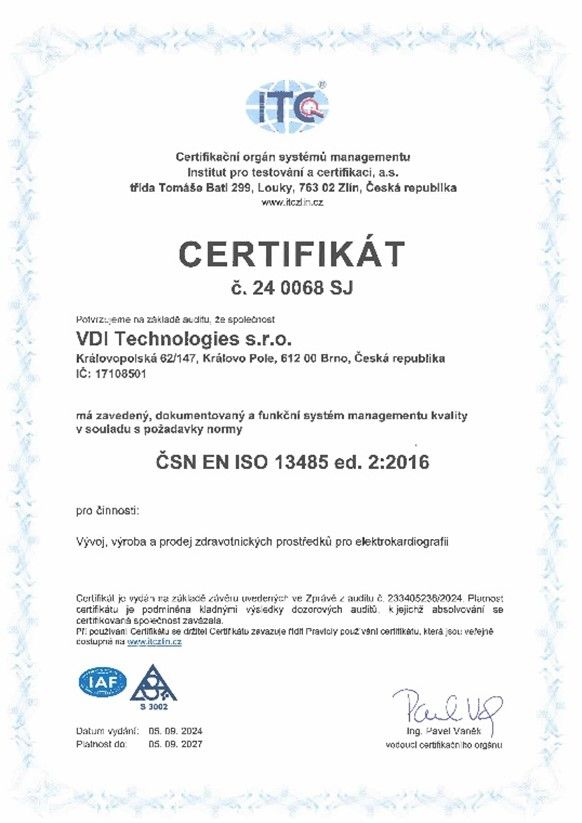
Certificate obtained by VDI Technologies s.r.o.
The VDI monitor (so-called Ventricular Dyssynchrony Imaging – a system using ultra-high-frequency ECG recording) can determine the optimal position of the pacemaker electrode in the heart directly during the procedure. While inserting the electrode, ECG is used, among other methods, but it does not guarantee the optimal placement of the electrode.
“VDI Monitor reveals not only which part of the heart is activated earlier and which later during pacemaker implantation, but also allows us to determine how large the delay is. The display is in real time, so the electrode position can be adjusted immediately during the operation,” explains Pavel Jurák, head of the Medical Signals Department at the Institute of Scientific Instruments of the Czech Academy of Sciences. The device can also be used for diagnostics. It can determine whether the patient is suitable for pacemaker implantation and there is growing potential for using the monitor during pacemaker setting.
The technology was fully designed and implemented in the Czech Republic, is protected by several international patents, and has received international recognition. In addition to the Institute of Scientific Instruments of the CAS, the Faculty Hospital at St. Anne’s in Brno, the University Hospital Královské Vinohrady in Prague, and the company Cardion also participated in the development. The use of this technology is very broad and covers the entire field of cardiac electrophysiology.
“CETAV is cooperating with ISI CAS on other projects where spin-offs may emerge. Thanks to the example of the VDI Technologies startup, other scientific teams at ISI are also showing interest in this model of commercializing their promising results,” adds Martin Smekal.
Contact:
Ing. Pavel Jurák, CSc., Head of the Medical Signals Department, Institute of Scientific Instruments of the CAS:
jurak@isibrno.cz
Ing. Martin Smekal, Head of the Technology Transfer Center of the CAS:
Smekal@ssc.cas.cz
Photo: ISI CAS